וַתִּקַּח֩ מִרְיָ֨ם הַנְּבִיאָ֜ה אֲח֧וֹת אַהֲרֹ֛ן אֶת־הַתֹּ֖ף בְּיָדָ֑הּ וַתֵּצֶ֤אןָ כׇֽל־הַנָּשִׁים֙ אַחֲרֶ֔יהָ בְּתֻפִּ֖ים וּבִמְחֹלֹֽת
Then Miriam the prophetess, Aaron’s sister, took a timbrel in her hand, and all the women went out after her in dance with timbrels.
Exodus 15:20
Discussion Questions
- Where could queer women be “hiding” in the passage?
- How does accounting for queer women impact the meaning of the text?
- What are the broader implications of this passage and its commentary?
Supplementary Material
WITH TIMBRELS AND WITH DANCES — The righteous women in that generation were confident that God would perform miracles for them and they accordingly had brought timbrels with them from Egypt (Mekhilta d’Rabbi Yishmael 15:20:2).
Rashi on Exodus 15:20
In another chamber, Yocheved comes, the mother of Moshe the faithful prophet, and so many thousands and thousands of women with her. In this chamber, there is no announcement at all, but three times each day, she acknowledges and praises the Ruler of the world, she and all the women with her. They sing the Song of the Sea every day, and she herself recites from “And Miriam the Prophet…took her timbrel in her hand…” (Shmot 15:20). And all these righteous women there in Gan Eden listen to her pleasant voice, and so many holy angels acknowledge and praise the holy Name with her.
The Zohar 2:167b
“I only go to a movie if it satisfies three basic requirements. One, it has to have at least two women in it who, two, talk to each other about, three something besides a man. […] The last movie I was able to see was Alien. The two women in it talk to each other about the monster.”
Alison Bechdel, Dykes to Watch Out For, “The Rule” (1985)
If you consider that the original comic strip came out at a time when lesbian-themed films were few and far between, and queer women largely had to make do with subtext (thus the Alien reference), not only was The Bechdel Test a way for women to enjoy films, but for queer women to seek out films that were not all heterosexual-themed love fests.
INTO MORE, “The Bechdel Test Is And Always Has Been Queer“
Commentary
Chava Session (Summer 2018)
Air
Sounds like “Prince of Egypt.”
Miriam left, women followed to dance together without their husbands. There’s joy in being with other women.
Water
According to Rav Huna, women being intimate with other women can stimulate sexual desire and therefore should be avoided. G-d can be worshiped through the joy women get in being together. G-d looks down happily at the joy women experience in a space exclusively for themselves and G-d.
Earth
Women can take joy and pleasure in each other—but not sexually. Female sexual life is seen as an Egyptian idea and cultural phenomenon and we don’t want to be like Egypt (our oppressors).
Fire
Disagree with Rabba Blue (Note: The in-person variant of the workshop distinguished each group by the color of pen or marker)—conduct of Egypt likely not a reference to feminine relations (sexual or non) but oppressive/genocidal intent, which was the purview of Egyptian men. Can’t be Egyptian conduct since this happens immediately after Passover. Egyptian conduct = slavery, not lesbianism, and men writing the seder.
Leah Session (Shavuot 2021)
Earth
Debbie Friedman’s queerness being evoked
Personal fulfillment, sense of joy in dancing for an intrinsic motivation rather than performative – not for male consumption
Bechdel test relevance:
– Miriam and the other women are not talking about men, but Aaron is mentioned as the qualifier for Miriam’s identity
– Miriam and the other women are talking about God— NOT a man
– maybe God is queer?
– like how the women in the Bechdel test comic strip are talking about an alien, the women in this text are talking about God
Fire
You do not need to be confident to want to dance
These sound like parties we would enjoy
The utopia of gan Eden Yocheved appears to be only with women not with her husband, suggesting that in a perfect world she is with women rather than with her husband. She also takes a non-normative gender role by praying three times a day but also centers it around her daughter rather than a prayer focused around a man.
she also makes the song of the sea an existing prayer rather than something purely spontaneous. Something authoured by a woman is taken into a the cannon, much like avenu malkanu.
Miriam is talking about God, not a man and their dance is not for male consumption.
This passage from the zohar gives us a non standard presentation of womens spirituality
This shows equality with men in the world to come, women are being treated as equal to men Much like rosh chodesh feminit ideas around restoring the moon. the same text could be written about men with a male bibilical charichters but would be less cool
The angels are there with all the non binary awesomeness that implies.
Air
Rashi text implies that ALL the women were righteous there. Zohar implying that women in the world to come were singing along too. Reading Miriam as queer, more so as a political statement (her having agency, speaking for people).
Spirit
The celebration is for a man, but performed by women
Miriam is textually gnc – she is one of the few women in torah who are named, who have agency, who have a story to begin with, but she only gets these because of her connection to aaron
She has a story, but her legitimacy is established through her connection to men
Women were off together most of the time, away from the eyes of the men
Women’s joy and women’s celebration, being all together and dancing and singing
Absence of inter-gender fellowship, prior to very recently – marriage was the main connection men and women had to each other, things were more homosocial
Marriage was much more perfunctory then than it is now, mainly for economic reasons or for having children
Miriam is separated from the rest of the women of the torah by her textually male characteristics – she is a leader to the women because of her association with the men and her male traits (having a story, having agency, even having a name are things awarded to men in the torah and generally not to women)
What do women have the opportunity to do when men aren’t watching?
A tradeoff – freedom for policing vs stories not being passed down generationally
Zilpah Session (Shavuot 2022)
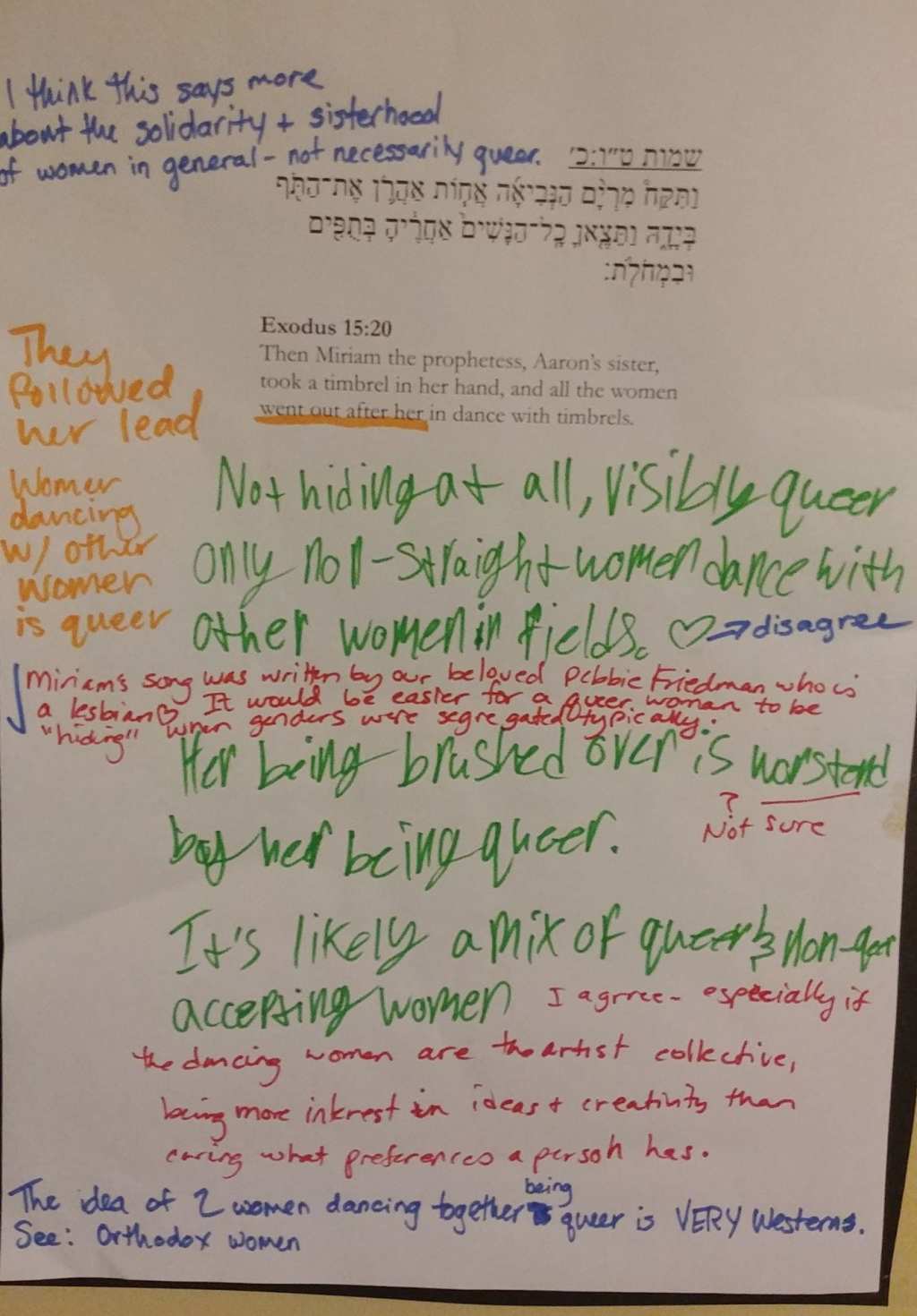
Earth
Not hiding at all, visibly queer
Only non-straight women dance with other women in fields ❤
Her being brushed over is worstened by her being queer
It’s likely a mix of queer and non-queer accepting women
Fire
Miram’s song was written by our beloved Debbie Friedman who is a lesbian <3. It would be easier for a queer woman to be “hiding” when genders were segregated typically.
I agree, especially if the dancing women are the artist collective, being more interested in ideas and creativity than caring what preferences a person has.
Air
They followed her lead. Women dancing with other women is queer.
Water
I think this says more about the solidarity and sisterhood of women in general — not necessarily queer
The idea of 2 women dancing together being queer is VERY Western. See: Orthodox women.
 Bizarro Torah
Leave a comment