As a fan of many characters deemed villains in their respective stories, redemption arcs are often a topic of discussion. Does this or that character deserve redemption? What makes for a satisfying redemption arc? Which redemption arcs work or don’t work?
However, it’s rare for me to come across a conversation that examines the concept of a redemption arc itself, let alone the forces that shape our understanding of what redemption means and how it works.
With that in mind, I’m going to see what I can do to crack open the assumptions behind redemption narratives and see what interesting alternatives present themselves.
As someone who studies Jewish texts as an entryway into Jewish ethics and values, the ways that majority gentile fandoms talk about characters transforming from villains to non-villains often strike me as reflecting Christian hegemony. Or, when speaking specifically of American media, puritanical Christian hegemony.
Redemption narratives are rooted in a deeply Christian framework where people do bad things because they are evil, sinful, or corrupt by nature. The task of redemption is to destroy or purge that corruption, and the surest way to do this is to suffer and die for others.
For an example of a redemption narrative, look no further than Anakin Skywalker. As Darth Vader, he murdered and terrorized his way across the galaxy for decades, but near the end of Return of the Jedi, he sacrifices himself to kill the Emperor and save Luke. Once he proved he still had good in him, he dies as Anakin Skywalker, fully redeemed.
While Christianity has redemption, in Judaism, the vehicle for character transformation is teshuvah. Although teshuvah is often translated as “repentance,” the Hebrew literally means “return.” The connotation is not so much related to confession and catharsis as realignment. In the Jewish worldview, we do things we shouldn’t because we’re messy, finite, and human. Through teshuvah, we have a path to fix things when we screw up and repair the relationship between ourselves and those we’ve wronged. Sometimes, such as in the case of murder, there is no making up for what we’ve done, so we must find a way to live with ourselves yet still strive to do better. In Judaism, the surest proof of having completed teshuvah is having the opportunity to make the same mistake as before but choosing differently.
Herein lies the difference between the Christian and the Jewish perspective. For the sake of brevity, Christianity says that redemption is about fixing what you are. But Judaism says that teshuvah is fixing what you’ve done.
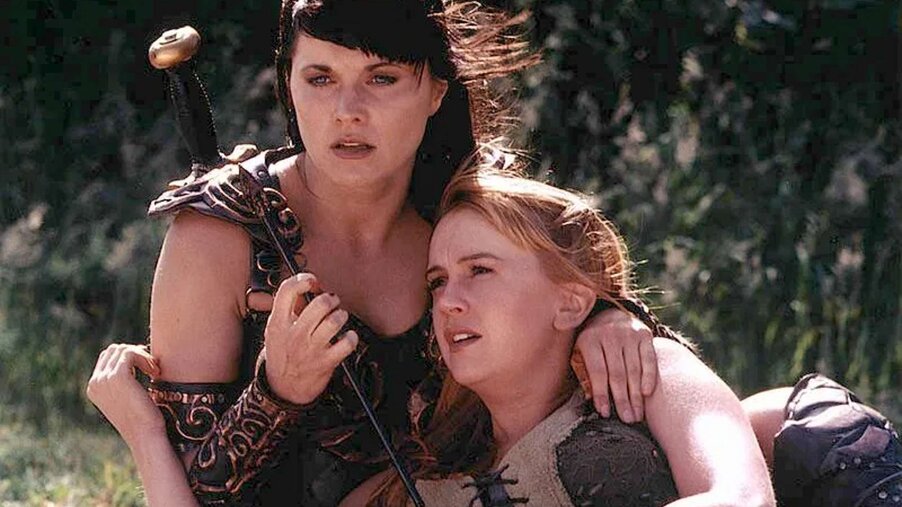
An example of a character arc that mirrors teshuvah is Xena in Xena: Warrior Princess. As Destroyer of Nations, Xena spent years in the pursuit of power and conquest, slaughtering countless people. But, inspired by Hercules, she realizes she can do better, so she does. She turns over a new leaf, using her strength, leadership, wits and skill to bring justice to the world and protect those who can’t protect themselves. She’s always struggling with ambition and bloodlust, and her reputation as a bloodthirsty conqueror follows her, but many times throughout the show, she chooses not to help people instead of kill them even if it would be easier for her to simply murder the weakling in charge and take over.
I don’t think that such character arcs are particularly rare. It’s just that fandom is so habituated to analyzing stories and characters through the lens of Christianity, usually without even knowing it, that alternatives aren’t recognized, let alone explored or examined.
For instance: Azula from Avatar: The Last Airbender. She’s such a layered, complex character, so full of possibilities, and she’s just plain fun. But on the show, she plays the role of villain. Fairly frequently, fandom will ask if Azula is redeemable or not.
At first, it seemed benign. Then certain patterns started cropping up in the language people were using to describe Azula. So much of it had these weird connotations of Original Sin. From the way a lot of people talked about her, it was as though she was condemned to damnation from birth, that her behavior is an expression of her morally corrupt nature, and that there was nothing she could do to change that.
That’s so jarring from a Jewish perspective. Judaism doesn’t deny that people are capable of wicked deeds. The Talmud is very clear that each of us has an impulse to do good and an impulse to do evil. We all mess up. That’s life. But when we mess up, teshuvah is always an option. We can always express regret our actions, seek to repair the harm we’ve done and commit to doing better. The idea that this 14-year-old girl, this child, is utterly beyond hope is unfathomable.
If fandoms could acknowledge and respect that different moral and ethical paradigms can inform character arcs, it could lead to some enriching discussions. But that’s not what happens. Instead, they apply this one narrow lens to all character arcs then judge the characters as inherently worthy or unworthy, and fandoms are poorer for it.
 Bizarro Torah