וְאֵ֛לֶּה תּוֹלְדֹ֥ת אַהֲרֹ֖ן וּמֹשֶׁ֑ה בְּי֗וֹם דִּבֶּ֧ר יְהֹוָ֛ה אֶת־מֹשֶׁ֖ה בְּהַ֥ר סִינָֽי׃ וְאֵ֛לֶּה שְׁמ֥וֹת בְּֽנֵי־אַהֲרֹ֖ן הַבְּכֹ֣ר ׀ נָדָ֑ב וַאֲבִיה֕וּא אֶלְעָזָ֖ר וְאִיתָמָֽר׃ אֵ֗לֶּה שְׁמוֹת֙ בְּנֵ֣י אַהֲרֹ֔ן הַכֹּהֲנִ֖ים הַמְּשֻׁחִ֑ים אֲשֶׁר־מִלֵּ֥א יָדָ֖ם לְכַהֵֽן׃
This is the line of Aaron and Moses at the time that the LORD spoke with Moses on Mount Sinai. (2) These were the names of Aaron’s sons: Nadab, the first-born, and Abihu, Eleazar and Ithamar; (3) those were the names of Aaron’s sons, the anointed priests who were ordained for priesthood.
Numbers 3:1-3
Discussion Questions
- Where could queer women be “hiding” in the passage?
- How does accounting for queer women impact the meaning of the text?
- What are the broader implications of this passage and its commentary?
Supplementary Material
אמר רבי שמואל בר נחמני א”ר יונתן כל המלמד בן חבירו תורה מעלה עליו הכתוב כאילו ילדו שנאמר (במדבר ג, א) ואלה תולדות אהרן ומשה וכתיב ואלה שמות בני אהרן לומר לך אהרן ילד ומשה לימד לפיכך נקראו על שמו
Rabbi Shmuel bar Naḥmani says that Rabbi Yonatan says: Anyone who teaches another person’s son Torah, the verse ascribes him credit as if he sired him, as it is stated: “Now these are the generations of Aaron and Moses” (Numbers 3:1), and it is written immediately afterward: “And these are the names of the sons of Aaron: Nadav the firstborn and Avihu, Eleazar, and Ithamar” (Numbers 3:2), but it does not mention the names of Moses’ children. This serves to say to you that Aaron sired his children, but Moses taught them Torah. Therefore, the children were also called by his name. [2]
Babylonian Talmud, Sanhedrin 19b:17
ואלה תולדת אהרן ומשה. וְאֵינוֹ מַזְכִּיר אֶלָּא בְנֵי אַהֲרֹן וְנִקְרְאוּ תוֹלְדוֹת מֹשֶׁה, לְפִי שֶׁלִּמְּדָן תּוֹרָה, מְלַמֵּד שֶׁכָּל הַמְלַמֵּד אֶת בֶּן חֲבֵרוֹ תּוֹרָה מַעֲלֶה עָלָיו הַכָּתוּב כְּאִלּוּ יְלָדוֹ:
AND THESE ARE THE OFFSPRING OF AARON AND MOSES — But it mentions only the sons of Aaron! But they also are called the sons of Moses because he taught them the Torah. This tells us that whoever teaches the Torah to the son of his fellow man Scripture regards it to him as though he had begotten him (Sanhedrin 19b).
Rashi on Numbers 3:1:1
“For women, the need and desire to nurture each other is not pathological but redemptive, and it is within that knowledge that our real power is rediscovered. […] Interdependency between women is the way to a freedom which allows I to be, not in order to be used, but in order to be creative. This is a difference between the passive be and the active being.”
Audre Lorde, “The Master’s Tools Will Never Dismantle the Master’s House,” Sister Outsider
Those of us who stand outside the circle of this society’s definition of acceptable women; those of us who have been forged in the crucibles of difference—those of us who are poor, who are lesbians, who are Black, who are older—know that survival is not an academic skill. It is learning how to stand alone, unpopular and sometimes reviled, and how to make common cause with those others identified as outside the structures in order to define and seek a world in which we can all flourish. It is learning to take our differences and make them strengths.
Audre Lorde, “The Master’s Tools Will Never Dismantle the Master’s House,” Sister Outsider
Commentary
Sarah Session (Winter 2018)
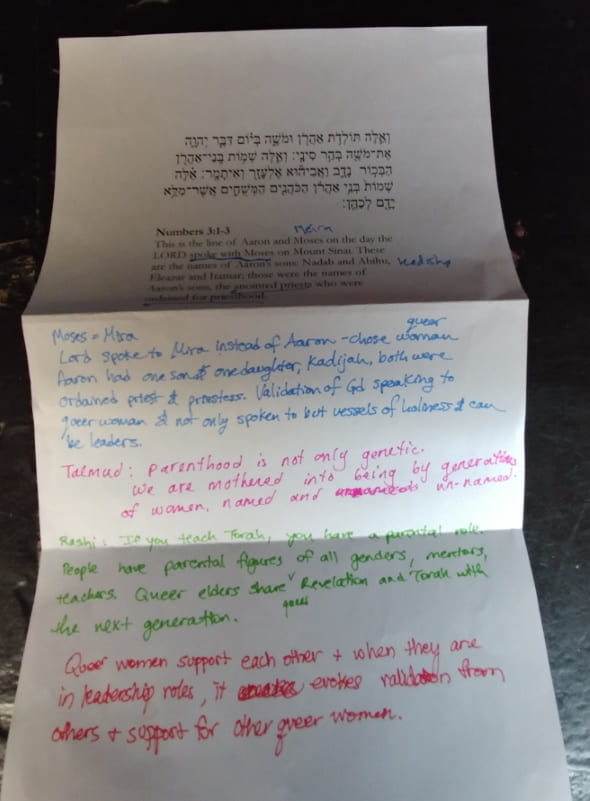
Air
Moses = Mira
Lord spoke to Mira instead of Aaron – chose queer woman
Aaron had one son and one daughter, Kadijah, both were ordained priest and priestess
Validation of Gd speaking to queer woman and not only spoken to but vessels of holiness and can be leaders
Water
Talmud: parenthood is not only genetic.
We are mothered into being by generations of women, named and un-named.
Earth
Rashi: If you teach Torah, you have a parental role. People have parental figures of all genders, mentors, teachers. Queer elders share queer revelation and Torah with the next generation.
Fire
Queer women support each other and when they are in leadership roles, it evokes validation from others and support for other queer women.
Rivka Session (Summer 2019)
Due to the prohibition of writing on Shabbat, this session was never recorded in written, audio, or video form.
Leah Session (Shavuot 2021)
Air
Exclusion of women – mothers, daughters, sisters erased from the texts
Judaism and childrearing – it’s a mitzvah for men to procreate, but who does the rearing?
Alternative styles of parenting – fostering, exchange students, teachers, etc are halachically important
Erasure of women is particularly striking
What counts halachically as parenting?
Taking care of others is a mitzvah – 2500 years after these texts, how do we implement that?
When we start to think about what family can be, queer family structures that involves all manner of pairings and parentings are so important.
There are things queer culture teaches that straight culture does not – e.g. chosen families
communal child-rearing, learning how to mother (as opposed to learning how to be a mother)
Queer families and parenting – how does access to reproductive technology change things?
Masculinity and fatherhood in the US – men get credit for doing the least amount of work
The bar is so low for cis men, meanwhile the people (mainly women) who do the actual work of raising, caring for, teaching the children, etc, are not credited
Nicki Minaj “all these bitches is my sons” – I taught these people how to rap, therefore they are my sons, I’m claiming them as my children
Different ways that people might claim parenthood by teaching things – torah, rap, queer interpretation of torah
Things that queer culture teaches that straight culture doesn’t teach – parenthood runs differently in queer communities than it does in straight communtiies
Teaching about queerness has to come from somewhere, and usually doesn’t come from straight parents
Water
This passage demonstrates the importance of found family – a concept we in the queer community are intimately familiar with. It is foundational, just like teaching Torah.
This passage demonstrates that adoption is a recognized way of creating family. One of the ways queer people established families in the past was through adoption, and this is still the case with people who can’t or choose not to have biological children.
This passage also shows how family dynamics can be built through knowledge and community outside of heteronormative family structures. For example, in our found families, we have people who become de facto parents, especially when biological family can be rejecting or in the case of learning skills to navigate a new community (e.g., Drag Mothers).
Earth
Learning builds family, and especially chosen family
learning from someone without giving them credit is the equivalent of dishonoring your parents
Who gets credit for parenting? What is the work of parenting? Who does that work?
LOVE the chosen family idea, AND where is the acknowledgement of the mother who birthed the sons?
there’s a queerness in the erasure
people on the margins (especially on the margins of queerness) lack a representation in society, and that parallels to lack of representation in this text
this passage feels like you have to choose between reading it as queer OR reading it as feminist
BUT interpretation by queer women counts!
 Bizarro Torah
Leave a comment