(יט) וְאֶל־אִשָּׁ֖ה בְּנִדַּ֣ת טֻמְאָתָ֑הּ לֹ֣א תִקְרַ֔ב לְגַלּ֖וֹת עֶרְוָתָֽהּ׃
(19) Do not come near a woman during her menstrual period of impurity to uncover her nakedness.
Leviticus 18:19
Discussion Questions
- Where could queer women be “hiding” in the passage?
- How does accounting for queer women impact the meaning of the text?
- What are the broader implications of this passage and its commentary?
Supplementary Material
What is the fence that the Torah made around its words? It says, “Do not come near woman during her period of impurity.” Perhaps [you would still think] one could hug her and kiss her and speak flirtatiously with her. So the verse tells you, “Do not come near.” Perhaps [you would still think] one could sleep next to her on the bed, as long as she was clothed. So the verse tells you, “Do not come near.” Perhaps [you would still think] she could wash her face and put makeup on her eyes. So the verse (Leviticus 15:33) tells you, “She is in her period of exile” – that is, all the days that she is in her period [of impurity], she will be in exile. Because of this they said: The spirit of the sages is pleased with anyone who makes herself unattractive during the days of her period [of impurity]. The spirit of the sages is displeased with anyone who makes herself attractive during the days of her period [of impurity].
Babylonial Talmud, Avot D’Rabbi Natan 2:1
According to Torah law, a woman is not rendered teme’ah and is not forbidden to her husband until she feels a sensation that blood left her body, but the sages decreed that upon seeing a blood stain on her body or clothing that she is teme’ah and forbidden to her husband even though she did not feel the blood leave her body, and even if she examines herself [afterwards] and finds herself clean. She requires a hefsek tahara to examine herself and find she is clean, and afterwards to count seven clean days from the day of her examination, as though she had certainly seen [niddah blood] as will be explained later in section 196. And if she felt that her uterus opened to release blood but checked herself afterward and did not find anything, there are those who say she is still teme’ah.
Shulchan Arukh, Yoreh De’ah 190:1
“For as long as there have been queer folks, people have been thinking about this topic, but I think that often this kind of oral Torah exists in the underground,” Soloman said. “There’s a moment now where those underground practices are being shared and are being asked more widely.”
Some of those questions have to do with how to apply laws created for a couple where only one person is menstruating to one where both are. Unless both partners’ periods start on the same day, they would end up observing a period longer than two weeks where they could not be intimate — and in some cases could last the whole month. To avoid this, many queer couples observe only the shorter period of niddah outlined in the bible.
“How queer Jews find meaning in the biblical laws of family purity,” The Times of Israel
Commentary
Rachel Session (August 2021)
Fire
queerness hidden, but women not necessarily so
hiding of trans women
coopting transmasculine people into womanhood
heteronormativity – assumption is that people who experience periods take precautions for men
two cis women in a relationship complicate the timekeeping
having sex during a period could be considered transgressive – is this a queer reading?
what makes things jewishly queer?
knowing the rules and knowing when to break them
can we reinterpret uncleanliness?
sanitary concerns from before, not necessarily the case now
does it make sense to try and push back on uncleanliness?
nice to take time away from partner and focus on yourself – but what when niddah takes up most of the month?
if you don’t have a standard menstrual cycle, where do you fit in? – amab women with no cycle or hormonal only, transmasculine people who no longer have cycles, people on birth control who have no or an irregular cycle
this is what queering the torah is – bringing the individuality, reinterpreting the rules for the people to whom they don’t apply
Air
Not all Queer Jewish women would follow this.
It mostly applies to the first two days, really, if she usually has a heavy period.
This would be messy for folks with irregular periods
It’s SO queer to be like “fuck you I wanna look hot for myself” or “fuck you, don’t tell me to look attractive I’m not here for your gaze”
That’s such queer energy
“not forbidden to her husband” what happens if it’s not her husband? what happens if it’s her wife?
Do rules apply if it’s not a het relationship? How do you pick and choose what you follow?
Similarly, is that not explicitly “queering” the Torah?
The story where Rachel has her period? Rachel, the wife of Jacob, lies about having her period because she’s sitting on the item that her father is looking for. What a power move. Another person in the Torah also lies about having her period so she gets out of doing something. Also a power move.
Seconding the comment about trans erasure and bioessentialism here
Spirit
There are assumptions!
Water
Bioessentialism sucks. This passage leaves much to be desired and is one passage that is so hard to accept any interpretation of. Is there any way to reinterpret “uncleanliness”? How important is the internal feeling of the menstruating person.
Even if I buy into this separation during this period, it is difficult to do without a stable home and community.
Rachel lied about her period to end idolatry.
Earth
– this passage is cisnormative
– the talmud is really adds a layer of disgust
– the term for impurity is also used for semen emmisions, childbirth, dead bodies, anything god doesn’t do has this impurity which is just another stat, there is wrong with it but the level vitriolic horror at the way afab peoples bodies work is something else (that’s why I don’t follow this – Bella)
– When is a woman who bleeds frequently and unpredictably meant to interact with people
– There is a clear lack of listening to women, a lack of real conversation with them
– THis is a command to men, it says nothing with women interaction with eachotehr, it created a woman only space
– there is a hypothesis that much of stringecy came from women, to get away from their husbands and because it was one of the few ways women could express their devotion
-what does it look like for community leaders
– all of this “exile” is about sexual relationships with men, that’s all it means for a woman to be exiled
– much of this could be liberation, but what happens if a man decides you’re still “tempting him”
– it’s easier to just stay away from men altogether (as usual)
-women self report all of this
Bilhah Session (Summer 2023)
Fire
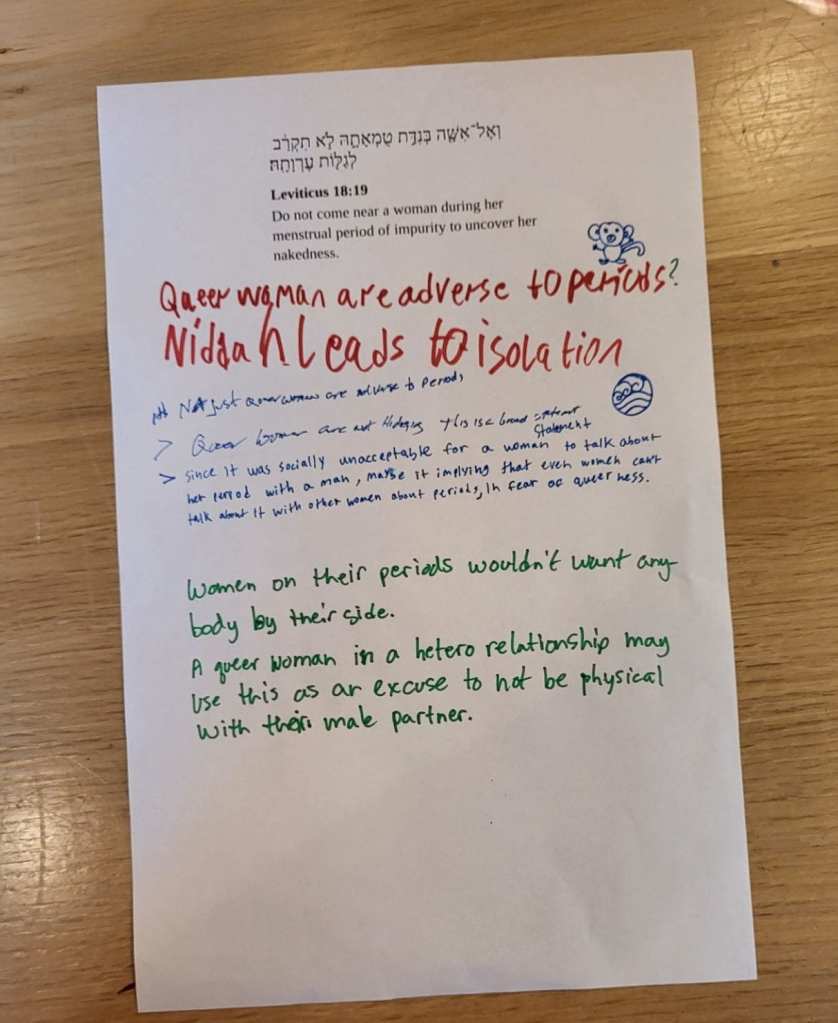
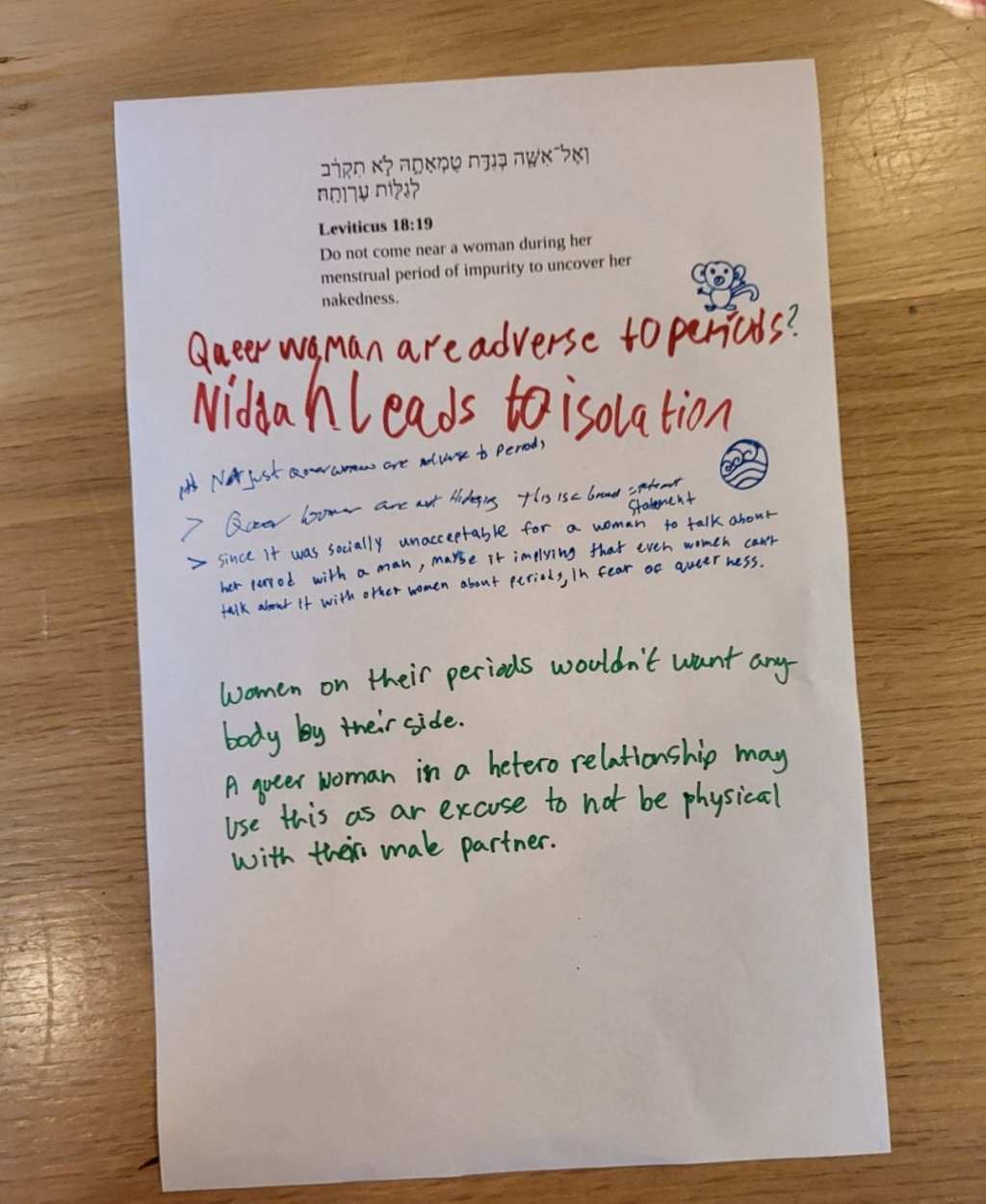
Queer women are adverse to periods
Niddah leads to isolation
Water
It’s N just Queer women are adverse to periods
Queer women are not hiding this is a broad statement
Since it was socially unacceptable for a woman to talk about her period with a man, maybe it implying that even women can’t talk about it with other women about periods, in fear of queerness.
Earth
Women on their periods wouldn’t want anybody by their side.
A queer woman in a hetero relationship may use this as an excuse to not be physical with their male partner.


Leave a Reply